


ゼアキサンチン【zeaxanthin】

ゼアキサンチン
| 分子式: | C40H56O2 |
| その他の名称: | ゼアキサンチン、ゼアキサントール、アンコビキサンチン、Zeaxanthin、Zeaxanthol、Anchovyxanthin、(3R,3'R)-β,β-Carotene-3,3'-diol、all-trans-ゼアキサンチン、all-trans-Zeaxanthin、β,β-Carotene-3β,3'β-diol、(3R,3'R)-ゼアキサンチン、(3R,3'R)-Zeaxanthin、3β,3'β-Dihydroxy-β,β-carotene |
| 体系名: | (3R,3'R)-β,β-カロテン-3,3'-ジオール、β,β-カロテン-3β,3'β-ジオール、3β,3'β-ジヒドロキシ-β,β-カロテン |
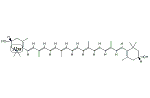

ゼアキサンチン
(Zeaxanthin から転送)
出典: フリー百科事典『ウィキペディア(Wikipedia)』 (2026/02/20 06:26 UTC 版)

|
|

|
|
| 物質名 | |
|---|---|
|
(3R,3′R)-β,β-Carotene-3,3′-diol |
|
|
(1R,1′R)-4,4′-[(1E,3E,5E,7E,9E,11E,13E,15E,17E)-3,7,12,16-Tetramethyloctadeca-1,3,5,7,9,11,13,15,17-nonaene-1,18-diyl]bis(3,5,5-trimethylcyclohex-3-en-1-ol)
|
|
| 識別情報 | |
|
3D model (JSmol)
|
|
| ChEBI | |
| ChemSpider | |
| ECHA InfoCard | 100.005.125 |
| E番号 | E161h (着色料) |
|
PubChem CID
|
|
| UNII | |
|
CompTox Dashboard (EPA)
|
|
|
|
|
|
| 性質 | |
| C40H56O2 | |
| モル質量 | 568.88 g/mol |
| 外観 | 赤橙色 |
| 融点 | 215.5 °C (419.9 °F; 488.6 K) |
| 溶けない | |
| 関連する物質 | |
| 関連物質 | ルテイン キサントフィル |
|
特記無き場合、データは標準状態 (25 °C [77 °F], 100 kPa) におけるものである。
|
|


ゼアキサンチン (zeaxanthin) は、自然界で最も一般的なカロテノイドの一つであり、キサントフィルサイクルを構成する三種のキサントフィルの一つである。
構造
ルテインとゼアキサンチンは独特の化学構造を持っており、互いに異性体の関係であるが、光学異性体ではない。これらの間に見られる大きな違いは、末端環にある二重結合の位置にあり、ルテインにはキラル中心が三つあるのに対して、ゼアキサンチンには二つしかない。
存在
植物
植物および一部の微生物で合成され、パプリカ、トウモロコシ、サフラン、クコの実(ゴジベリー)、その他多くの植物や微生物に特徴的な色を与える色素である[1][2]。また、サフランの味や香りのもとであるサフラナールへと、前駆体であるピクロクロシンを経て分解される[3]。ルテインやゼアキサンチンの含有量が多い食べ物はケールやほうれん草、カブの葉、コラードグリーン、ロメインレタス、クレソン、フダンソウ、カラシナといった濃い緑色の葉物野菜である[4]。
動物
動物では目の網膜に含まれ、黄斑中央部において主要な構成物質であるが、網膜周辺部位ではルテインが主要な構成物質である。
岐阜薬科大学のグループの研究によると、長良川の天然アユの目にはゼアキサンチンが多く含まれている。マアジの目の部位のカロテノイド含有量は3μgでうちゼアキサンチンは20.1%だったのに対し、アユは552μg中78.3%含まれていた[5]。
機能
ゼアキサンチンなどのキサントフィルは、ほとんどの緑色植物の葉に最も多く存在し、そこで光エネルギーを調節する役割を果たす。また、光合成時に高照度下で過剰生成される三重項クロロフィル(励起状態のクロロフィル)に処する非光化学的消光剤として機能する可能性がある[6]。気孔細胞内のゼアキサンチンは青色光受容体として機能し、気孔の開閉を調節する[7]。
動物は植物性食物からゼアキサンチンを摂取する[2]。ゼアキサンチンは目の網膜内に存在する二大キサントフィルカロテノイドの一つである。ゼアキサンチンサプリメントは通常、目の健康維持を目的として摂取される。摂取による副作用は報告されていないが、ゼアキサンチンとルテインの実際の健康効果は証明されておらず[8][9][10]、2018年現在、欧州連合(EU)および米国においてゼアキサンチン含有製品の健康効果に関する表示は規制当局の承認を得ていない。
食品添加物として、ゼアキサンチンは食品着色料であり、E番号E161hで指定されている。
異性体と黄斑部への取り込み
ルテインとゼアキサンチンは化学式が同一の異性体であるが、立体異性体ではない。両者の唯一の違いは、末端環のいずれかにおける二重結合の位置にある。この差異により、ルテインは3つのキラル中心を持つ一方、ゼアキサンチンは2つしか持たない。対称性のため、ゼアキサンチンの(3R,3′S)および(3S,3′R)立体異性体は同一である。したがって、ゼアキサンチンには3つの立体異性体形態しか存在しない。(3R,3′S)立体異性体はメソゼアキサンチンと呼ばれる。
ゼアキサンチンの主な天然型は(3R,3′R)ゼアキサンチンである。黄斑部には主に(3R,3′R)ゼアキサンチンとメソゼアキサンチンが含まれるが、ごく微量の第三型(3S,3′S)ゼアキサンチンも存在する[11]。特定のゼアキサンチン結合タンパク質が、循環するゼアキサンチンとルテインを募って、黄斑内への取り込みを促進するという証拠が存在する[12]。
カロテノイドの商業的価値から、その生合成は天然物および大腸菌や酵母などの非天然(異種)システムにおいて広範に研究されてきた。ゼアキサンチンの生合成は、β-カロテンから始まり、β-カロテン水酸化酵素として知られる単一のタンパク質の作用により進行する。この酵素はβ-カロテン分子の3位および3′位に水酸基(-OH)を付加することができる。したがって、ゼアキサンチンの生合成は、β-カロテンからβ-クリプトキサンチン(モノヒドロキシル化中間体)を経由し、ゼアキサンチン(ジヒドロキシル化生成物)へと進行する。機能的には同一であるが、いくつかの異なるβ-カロテンヒドロキシラーゼタンパク質が知られている。
ゼアキサンチンの性質上、商業的価値の高いカロテノイドであるアスタキサンチンと比較して、β-カロテンヒドロキシラーゼタンパク質は広く研究されてきた[13]。
眼疾患との関係
いくつかの観察研究、特に加齢性眼疾患研究(AREDS2)では、ルテインやゼアキサンチンを含む食品を多く摂取すると加齢黄斑変性(AMD)の発症率が低下するという予備的な証拠が得られている[14][15]。これらのカロテノイドのいずれかを多く含む食品は、他のカロテノイドも多く含む傾向があるため、研究では一方の効果ともう一方の効果を区別していない[16][17]。
- その後行われた食事中のルテインとゼアキサンチンに関する3つのメタアナリシスでは、これらのカロテノイドがAMDの初期段階から後期段階への進行リスクを低下させるという結論が出された[18][19][20]。
- しかし、2023年に複数の国で行われた26件の研究を対象としたコクランレビューでは、ゼアキサンチンとルテインを含む栄養補助食品はAMDの進行にほとんど影響を与えないか、全く影響を与えないと結論付けられた[21]。一般的に、食事またはサプリメントとしてのゼアキサンチンまたはルテインが早期AMDの治療または予防に有効であるかどうかを評価するには、根拠が不十分である[2][21][16]。
白内障に関しては、2つのメタアナリシスで、血清中のルテインおよびゼアキサンチンの高濃度と核白内障のリスク低下との相関関係が確認されているが、皮質白内障や嚢下白内障のリスク低下との相関関係は確認されていない。これらの報告では、ゼアキサンチンの効果とルテインの効果を区別してはいない[22][23]。AREDS2試験では、進行性加齢黄斑変性症への進行リスクのある被験者が登録された。全体として、ルテイン(10 mg)とゼアキサンチン(2 mg)を摂取した群では、白内障手術の必要性が減少しなかった[24]。ヘビースモーカー、アルコール依存症者、カロテノイドを豊富に含む食品の摂取量が少ない人など、高い酸化ストレスにさらされている集団では、何らかの効果がより顕著に現れる可能性が高い[25]。
2005年、米国食品医薬品局(FDA)は、ルテインとゼアキサンチンを含むサプリメントが加齢黄斑変性症(AMD)の予防に有効であることを裏付ける根拠が不十分であるとして、ザンゴールド社の限定的健康強調表示(Qualified Health Claims)申請を却下した[26]。米国の栄養補助食品会社は、FDAの免責事項をラベルに記載すれば、「目の健康維持に役立ちます」などの栄養補助食品の効能を謳ったルテインおよびルテインとゼアキサンチンの配合製品を販売することが認められている。欧州では、2014年に、欧州食品安全機関(EFSA)がルテインまたはルテインとゼアキサンチンの配合が視力を改善するという主張を審査し、却下した[27]。
天然のゼアキサンチン
天然に存在するゼアキサンチンは、パプリカ、トウモロコシ、サフラン、クコの実(ゴジベリー)、その他多くの植物に赤、オレンジ、黄色といった特徴的な色を与える色素である[2][21]。スピルリナもゼアキサンチンの豊富な供給源であり、栄養補助食品として利用できる[28]。ゼアキサンチンは分解するとピクロクロシンとサフラナールとなり、サフランの味と香りのもとになる[29]。ケール、ほうれん草、カブの葉、コラードグリーン、ロメインレタス、クレソン、スイスチャード、カラシナなどの濃い緑色の葉野菜にはルテインが豊富であるが[2][30]、油で調理したネギを除いてゼアキサンチンはほとんど含まれていないか、まったく含まれていない[31]。オレンジ色のピーマン(緑、赤、黄色は含まない)にはゼアキサンチンが豊富である[31]。
安全性
ゼアキサンチンの許容一日摂取量は、体重1kgあたり0.75 mg/日、または体重70kgの成人で53 mg/日と提案されている[32]。ヒトでは、1日20 mgを最大6ヶ月間摂取しても悪影響はなかった[32]。2016年時点で、米国食品医薬品局も欧州食品安全機関も、ルテインまたはゼアキサンチンの許容上限摂取量(UL)を設定していない。
出典
- ^ Encyclopedia.com. “Carotenoids”. 2012年5月6日閲覧。
- ^ a b c d e “Lutein + Zeaxanthin Content of Selected Foods”. Linus Pauling Institute, Oregon State University, Corvallis (2014年). 2014年5月20日閲覧。
- ^ Figure 1 - uploaded by Sara Gharavi ResearchGate. Naik et al., 2003
- ^ オレゴン州立大学微量栄養素情報センター. “カロテノイド”. 2019年3月25日閲覧。
- ^ “天然色素「ゼアキサンチン」 天然アユの目に多く”. 中日新聞. (2020年8月14日)
{{cite news}}: CS1メンテナンス: 先頭の0を省略したymd形式の日付 (カテゴリ) - ^ Bassi, Roberto; Dall'Osto, Luca (2021). “Dissipation of Light Energy Absorbed in Excess: The Molecular Mechanisms”. Annual Review of Plant Biology 72: 47–76. doi:10.1146/annurev-arplant-071720-015522. PMID 34143647.
- ^ Kochhar, S. L.; Gujral, Sukhbir Kaur (2020). “Transpiration”. Plant Physiology: Theory and Applications (2 ed.). Cambridge University Press. pp. 75–99. doi:10.1017/9781108486392.006. ISBN 978-1-108-48639-2
- ^ Age-Related Eye Disease Study 2 Research Group (2013). “Lutein + zeaxanthin and omega-3 fatty acids for age-related macular degeneration: The Age-Related Eye Disease Study 2 (AREDS2) randomized clinical trial”. JAMA 309 (19): 2005–15. doi:10.1001/jama.2013.4997. PMID 23644932.
- ^ Pinazo-Durán, M. D.; Gómez-Ulla, F; Arias, L et al. (2014). “Do Nutritional Supplements Have a Role in Age Macular Degeneration Prevention?”. Journal of Ophthalmology 2014: 1–15. doi:10.1155/2014/901686. PMC 3941929. PMID 24672708.
- ^ Koo, E; Neuringer, M; Sangiovanni, J. P. (2014). “Macular xanthophylls, lipoprotein-related genes, and age-related macular degeneration”. American Journal of Clinical Nutrition 100 (Supplement 1): 336S–346S. doi:10.3945/ajcn.113.071563. PMC 4144106. PMID 24829491.
- ^ Nolan, J. M.; Meagher, K; Kashani, S; Beatty, S (2013). “What is meso-zeaxanthin, and where does it come from?”. Eye 27 (8): 899–905. doi:10.1038/eye.2013.98. PMC 3740325. PMID 23703634.
- ^ Li, B; Vachali, P; Bernstein, P. S. (2010). “Human ocular carotenoid-binding proteins”. Photochemical & Photobiological Sciences 9 (11): 1418–25. Bibcode: 2010PhPhS...9.1418L. doi:10.1039/c0pp00126k. PMC 3938892. PMID 20820671.
- ^ Scaife, Mark A.; Ma, Cynthia A.; Ninlayarn, Thanyanun et al. (22 May 2012). “Comparative Analysis of β-Carotene Hydroxylase Genes for Astaxanthin Biosynthesis”. Journal of Natural Products 75 (6): 1117–24. doi:10.1021/np300136t. PMID 22616944.
- ^ “NIH study provides clarity on supplements for protection against blinding eye disease”. US National Eye Institute, National Institutes of Health, Bethesda, MD (2013年5月5日). 2019年8月15日時点のオリジナルよりアーカイブ。2017年8月10日閲覧。
- ^ Bernstein, P. S.; Li, B; Vachali, P. P. et al. (2015). “Lutein, Zeaxanthin, and meso-Zeaxanthin: The Basic and Clinical Science Underlying Carotenoid-based Nutritional Interventions against Ocular Disease”. Progress in Retinal and Eye Research 50: 34–66. doi:10.1016/j.preteyeres.2015.10.003. PMC 4698241. PMID 26541886.
- ^ a b “Nutritional supplements for age-related macular degeneration”. Current Opinion in Ophthalmology 21 (3): 184–9. (May 2010). doi:10.1097/ICU.0b013e32833866ee. PMC 2909501. PMID 20216418.
- ^ “The relationship of dietary carotenoid and vitamin A, E, and C intake with age-related macular degeneration in a case-control study: AREDS Report No. 22”. Archives of Ophthalmology 125 (9): 1225–1232. (September 2007). doi:10.1001/archopht.125.9.1225. PMID 17846363.
- ^ “Lutein and zeaxanthin supplementation and association with visual function in age-related macular degeneration”. Invest. Ophthalmol. Vis. Sci. 56 (1): 252–8. (2014). doi:10.1167/iovs.14-15553. PMID 25515572.
- ^ “Role of lutein supplementation in the management of age-related macular degeneration: meta-analysis of randomized controlled trials”. Ophthalmic Res. 52 (4): 198–205. (2014). doi:10.1159/000363327. PMID 25358528.
- ^ “Lutein and zeaxanthin intake and the risk of age-related macular degeneration: a systematic review and meta-analysis”. Br. J. Nutr. 107 (3): 350–9. (2012). doi:10.1017/S0007114511004260. PMID 21899805.
- ^ a b c Evans, Jennifer R.; Lawrenson, John G. (2023-09-13). “Antioxidant vitamin and mineral supplements for slowing the progression of age-related macular degeneration”. The Cochrane Database of Systematic Reviews 2023 (9). doi:10.1002/14651858.CD000254.pub5. ISSN 1469-493X. PMC 10498493. PMID 37702300.
- ^ “Association between lutein and zeaxanthin status and the risk of cataract: a meta-analysis”. Nutrients 6 (1): 452–65. (2014). doi:10.3390/nu6010452. PMC 3916871. PMID 24451312.
- ^ “A dose-response meta-analysis of dietary lutein and zeaxanthin intake in relation to risk of age-related cataract”. Graefes Arch. Clin. Exp. Ophthalmol. 252 (1): 63–70. (2014). doi:10.1007/s00417-013-2492-3. PMID 24150707.
- ^ “Lutein/zeaxanthin for the treatment of age-related cataract: AREDS2 randomized trial report no. 4”. JAMA Ophthalmol 131 (7): 843–50. (2013). doi:10.1001/jamaophthalmol.2013.4412. PMC 6774801. PMID 23645227.
- ^ “Nutrition and the prevention of cataracts”. Current Opinion in Ophthalmology 19 (1): 66–70. (January 2008). doi:10.1097/ICU.0b013e3282f2d7b6. PMID 18090901.
- ^ “Letter of Denial - Xangold Lutein Esters, Lutein, or Zeaxanthin and Reduced Risk of Age-related Macular Degeneration or Cataract Formation (Docket No. 2004Q-0180”. US FDA, Qualified Health Claims (2005年12月19日). 2014年5月21日時点のオリジナルよりアーカイブ。2026年2月20日閲覧。
- ^ “Scientific Opinion on the substantiation of a health claim related to a combination of lutein and zeaxanthin and improved vision under bright light conditions pursuant to Article 13(5) of Regulation (EC) No 1924/2006”. EFSA Journal 12 (7): 3753. (2014). doi:10.2903/j.efsa.2014.3753. ISSN 1831-4732.
- ^ Yu, B.; Wang, J.; Suter, P. M. et al. (2012). “Spirulina is an effective dietary source of zeaxanthin to humans”. British Journal of Nutrition 108 (4): 611–619. doi:10.1017/S0007114511005885. PMID 22313576.
- ^ Frusciante, Sarah; Diretto, Gianfranco; Bruno, Mark et al. (2014-08-19). “Novel carotenoid cleavage dioxygenase catalyzes the first dedicated step in saffron crocin biosynthesis” (英語). Proceedings of the National Academy of Sciences 111 (33): 12246–12251. Bibcode: 2014PNAS..11112246F. doi:10.1073/pnas.1404629111. ISSN 0027-8424. PMC 4143034. PMID 25097262.
- ^ “Foods highest in lutein-zeaxanthin per 100 grams”. Conde Nast for the USDA National Nutrient Database, release SR-21 (2014年). 2015年12月23日閲覧。
- ^ a b Alisa Perry; Helen Rasmussen; Elizabeth J. Johnson (Feb 2009). “Xanthophyll (lutein, zeaxanthin) content in fruits, vegetables and corn and egg products”. Journal of Food Composition and Analysis 22 (1): 9–15. doi:10.1016/j.jfca.2008.07.006 2024年2月4日閲覧。.
- ^ a b “Zeaxanthin: Review of Toxicological Data and Acceptable Daily Intake”. Journal of Ophthalmology 2016: 1–15. (2016). doi:10.1155/2016/3690140. PMC 4738691.
PMID 26885380. "
• In their evaluation of the safety of synthetic zeaxanthin as a Novel Food, the EFSA NDA Scientific Panel [37] applied a 200-fold safety factor to this NOAEL to define an ADI of 0.75 mg/kg bw/day, or 53 mg/day for a 70 kg adult.
• Formulated zeaxanthin was not mutagenic or clastogenic in a series of in vitro and in vivo tests for genotoxicity.
• Information from human intervention studies also supports that an intake higher than 2 mg/day is safe, and an intake level of 20 mg/day for up to 6 months was without adverse effect."
外部リンク
| 典拠管理データベース: 国立図書館 |
|---|
- Zeaxanthinのページへのリンク


