




1,2,3,4-シクロブタンテトラオン
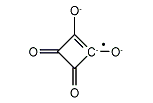
1,2-ジオキシラト-3,4-ジオキソシクロブテン-1-ラジカルアニオン
| 分子式: | C4O4 |
| その他の名称: | 1,2-Dioxylato-3,4-dioxocyclobutene-1-radical anion |
| 体系名: | 1,2-ジオキシラト-3,4-ジオキソシクロブテン-1-ラジカルアニオン |
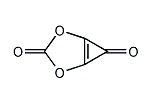
2,4-ジオキサビシクロ[3.1.0]ヘキサ-1(5)-エン-3,6-ジオン
| 分子式: | C4O4 |
| その他の名称: | 2,4-Dioxabicyclo[3.1.0]hexa-1(5)-ene-3,6-dione |
| 体系名: | 2,4-ジオキサビシクロ[3.1.0]ヘキサ-1(5)-エン-3,6-ジオン |
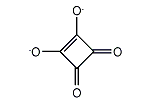
2‐ブチン二酸アニオン

3,4-ジオキソ-1,2-ジオキシラト-1-シクロブテン
| 分子式: | C4O4 |
| その他の名称: | 3,4-Dioxo-1,2-dioxylato-1-cyclobutene、3,4-Dioxylato-3-cyclobutene-1,2-dione、スクエア酸ジアニオン、Squaric acid dianion、1,2-Dioxylatocyclobutene 3,4-dione、1,2-Dioxylatocyclobutene-3,4-dione、3,4-Dioxocyclobutene-1,2-diol anion、1,2-Dioxylato-3,4-dioxo-1-cyclobutene、3,4-Dioxo-1-cyclobutene-1,2-diol anion |
| 体系名: | 3,4-ジオキソ-1,2-ジオキシラト-1-シクロブテン、3,4-ジオキシラト-3-シクロブテン-1,2-ジオン、1,2-ジオキシラトシクロブテン3,4-ジオン、1,2-ジオキシラトシクロブテン-3,4-ジオン、3,4-ジオキソシクロブテン-1,2-ジオールアニオン、1,2-ジオキシラト-3,4-ジオキソ-1-シクロブテン、3,4-ジオキソ-1-シクロブテン-1,2-ジオールアニオン |

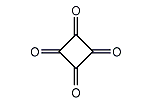
シクロブタンテトロン
(C4O4 から転送)
出典: フリー百科事典『ウィキペディア(Wikipedia)』 (2018/04/29 21:28 UTC 版)
| シクロブタンテトロン | |
|---|---|
 |
|
|
別称
Tetraoxocyclobutane
|
|
| 識別情報 | |
| CAS登録番号 | 3617-57-0  |
| ChemSpider | 24735246  |
|
|
|
|
| 特性 | |
| 化学式 | C4O4 |
| モル質量 | 112.04 g mol−1 |
| 精密質量 | 111.979658488 g mol-1 |
| 特記なき場合、データは常温 (25 °C)・常圧 (100 kPa) におけるものである。 | |
シクロブタンテトロン(Cyclobutanetetrone)またはテトラオキソシクロブタン(Tetraoxocyclobutane)は、C4O4または(-(C=O)-)4の化学式を持ち、シクロブタンの四重ケトンである有機化合物である[1]。オキソカーボンであり、一酸化炭素の四量体と見ることもできる。
この化合物は、熱力学的に不安定であると考えられている[2]。2000年時点で、大量合成はできていないが[3][4]、質量分析法では遷移状態として存在することが検出されている[5]。
関連化合物
シクロブタンテトロンは、少なくとも1959年から知られていた安定なスクアリン酸イオンC4O42-に対応する中性物質として見ることもできる[6]。
オクタヒドロキシシクロブタン(-C(OH)2-)4は、「水和したシクロブタンテトロン」と言うことができる[7]。
関連項目
出典
- ^ Guo, J.-C.; Hou, G.-L.; Li, S.-D.; Wang, X.-B. (2012). “Probing the Low-Lying Electronic States of Cyclobutanetetraone (C4O4) and Its Radical Anion: A Low-Temperature Anion Photoelectron Spectroscopic Approach”. Journal of Physical Chemistry A 3 (3): 304-308. doi:10.1021/jz201593z.
- ^ Jiao, H.; Frapper, G.; Halet, J.-F.; Saillard, J.-Y. (2001). “Stability of Tetraoxocyclobutane Revised: Perturbation Theory and Density Functional Scheme”. Journal of Physical Chemistry Letters 105 (24): 5945-5947. doi:10.1021/jp010738i.
- ^ Rubin, M. B.; Gleiter, R. (2000). “The Chemistry of Vicinal Polycarbonyl Compounds”. Chemical Reviews 100 (3): 1121?1164. doi:10.1021/cr960079j. PMID 11749259.
- ^ Seitz, G.; Imming, P. (1992). “Oxocarbons and pseudooxocarbons”. Chemical Reviews 92 (6): 1227?1260. doi:10.1021/cr00014a004.
- ^ Schroder, D.; Schwarz, H.; Dua, S.; Blanksby, S. J.; Bowie, J. H. (1999). “Mass spectrometric studies of the oxocarbons CnOn (n = 3?6)”. International Journal of Mass Spectrometry 188 (1?2): 17?25. doi:10.1016/S1387-3806(98)14208-2.
- ^ Cohen, S.; Lacher, J. R.; Park, J. D. (1959). “Diketocyclobutanediol”. Journal of the American Chemical Society 81 (13): 3480. doi:10.1021/ja01522a083.
- ^ Skujins, S.; Delderfield, J.; Webb, G. A. (1967). “A mass spectrometric study of some monocyclic polycarbonyl compounds”. Tetrahedron 24 (13): 4805?4817. doi:10.1016/S0040-4020(01)98676-4.
- Maahs, G.; Hegenberg, P. (2003). “Syntheses and Derivatives of Squaric Acid”. Angewandte Chemie International Edition 5 (10): 888?893. doi:10.1002/anie.196608881.
|
||||||||
- C4O4のページへのリンク


