




パルミトイルエタノールアミド
| 分子式: | C18H37NO2 |
| その他の名称: | インプルシン、パルミドロール、Impulsin、Palmidrol、パルミチン酸モノエタノールアミド、N-(2-Hydroxyethyl)palmitic amide、N-(2-ヒドロキシエチル)パルミチン酸アミド、Palmitic acid monoethanolamide、N-(2-Hydroxyethyl)hexadecanamide、N-(2-Hydroxyethyl)palmitamide、ローラミンP-256、Loramine P-256、パルミチルエタノールアミド、Palmitylethanolamide、N-パルミトイルエタノールアミン、N-Palmitoylethanolamine、AM-3112、パルミトイルエタノールアミド、Palmitoylethanolamide、N-パルミトイルエタノールアミド、N-Palmitoylethanolamide、PalEtn、2-(Palmitoylamino)ethanol、2-Palmitoylaminoethanol |
| 体系名: | 2-(パルミトイルアミノ)エタノール、2-パルミトイルアミノエタノール、N-(2-ヒドロキシエチル)パルミトアミド、N-(2-ヒドロキシエチル)ヘキサデカンアミド |
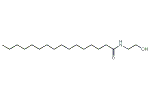

パルミトイルエタノールアミド
(Palmitoylethanolamide から転送)
出典: フリー百科事典『ウィキペディア(Wikipedia)』 (2026/01/20 15:05 UTC 版)

|
|
| 物質名 | |
|---|---|
|
別名
|
|
| 識別情報 | |
|
3D model (JSmol)
|
|
| 略称 | PEA |
| ChEMBL | |
| ChemSpider | |
| ECHA InfoCard | 100.008.062 |
| EC番号 |
|
| KEGG | |
| MeSH | palmidrol |
|
PubChem CID
|
|
| UNII | |
|
CompTox Dashboard (EPA)
|
|
|
|
|
|
| 性質 | |
| C18H37NO2 | |
| モル質量 | 299.499 g·mol−1 |
| 外観 | White crystals |
| 密度 | 910 mg mL−1 |
| 融点 | 93 - 98 °C (199 - 208 °F; 366 - 371 K) |
| log POW | 5.796 |
| 危険性 | |
| 引火点 | 323.9 °C (615.0 °F; 597.0 K) |
| 関連する物質 | |
| 関連物質 |
|
|
特記無き場合、データは標準状態 (25 °C [77 °F], 100 kPa) におけるものである。
|
|


Palmitoylethanolamide、略称はPEA[2]、内因性脂肪酸アミドの一種であり[3][4]、抗炎症鎮痛作用がある[5]。天然に存在する生物学的に活性な脂質で、動物や植物にも存在する[6]。PEAの主要な標的の1つはペルオキシソーム増殖剤活性化受容体(PPAR−α)であると考えられている[7][8]。PEAはカンナビノイド受容体GPR55およびGPR119に対しても親和性を有する[9]。
研究と生産
Palmitoylethanolamide、1957年に発見され[10][11]、食品や多くの生体内に生理活性成分として存在している[12]。消炎鎮痛薬としての適応症は1980年以前にさかのぼる。1990年代半ばには、PEAとの関係が記述されている[13]。2021年4月、中国に拠点を置く医薬品メーカー[14]CofttekはPEAの大量生産を導入した[15]。
脚注
- ^ NCBI-PubChem Staff (2005年3月25日). “Compound Summary: Palmitoylethanolamide” (database entry). PubChem.NCBI.NLM.NIH.gov. Bethesda, MD: US NLM-National Center for Biotechnology Information (NCBI). 2020年2月26日閲覧。
- ^ “Palmitoylethanolamide controls reactive gliosis and exerts neuroprotective functions in a rat model of Alzheimer’s disease”. Nature (Cell Death and Disease). (2014年9月11日)
- ^ Ronald Ross Watson; Victor R. Preedy (11 September 2014). Bioactive Nutraceuticals and Dietary Supplements in Neurological and Brain Disease: Prevention and Therapy. Academic Press. pp. 166–. ISBN 978-0-12-411529-3
- ^ “Palmitoylethanolamide induces microglia changes associated with increased migration and phagocytic activity: involvement of the CB2 receptor”. Nature (Scientific Reports). (2017年3月23日)
- ^ Nervous System Trauma: New Insights for the Healthcare Professional: 2013 Edition: ScholarlyBrief. ScholarlyEditions. (22 July 2013). pp. 15–. ISBN 978-1-4816-5451-7
- ^ Chiara Noli; Silvia Colombo (15 June 2020). Feline Dermatology. Springer Nature. pp. 484–. ISBN 978-3-030-29836-4
- ^ “Cannabinoids go nuclear: evidence for activation of peroxisome proliferator-activated receptors”. British Journal of Pharmacology 152 (5): 576–82. (November 2007). doi:10.1038/sj.bjp.0707423. PMC 2190029. PMID 17704824.
- ^ “The nuclear receptor peroxisome proliferator-activated receptor-alpha mediates the anti-inflammatory actions of palmitoylethanolamide”. Molecular Pharmacology 67 (1): 15–9. (January 2005). doi:10.1124/mol.104.006353. PMID 15465922.
- ^ Godlewski G, Offertáler L, Wagner JA, Kunos G (September 2009). “Receptors for acylethanolamides-GPR55 and GPR119”. Prostaglandins & Other Lipid Mediators 89 (3–4): 105–11. doi:10.1016/j.prostaglandins.2009.07.001. PMC 2751869. PMID 19615459.
- ^ Hesselink, Jan M Keppel; Kopsky, David J. “Palmitoylethanolamide, a neutraceutical, in nerve compression syndromes: efficacy and safety in sciatic pain and carpal tunnel syndrome”. National Center for Biotechnology Information (Journal of Pain Research) 8. doi:10.2147/JPR.S93106. PMID 26604814.
- ^ Hesselink, J. M. Keppel; Boer, Tineke de; Witkamp, Renger F. (3 June 2021). “Palmitoylethanolamide: A Natural Body-Own Anti-Inflammatory Agent, Effective and Safe against Influenza and Common Cold”. National Center for Biotechnology Information (International Journal of Inflammation) 2013. doi:10.1155/2013/151028. PMID 24066256 2021年6月3日閲覧。.
- ^ Hesselink, Jan M. Keppel; Costagliola, Ciro; Fakhry, Josiane; Kopsky, David J.. “Palmitoylethanolamide, a Natural Retinoprotectant: Its Putative Relevance for the Treatment of Glaucoma and Diabetic Retinopathy”. National Center for Biotechnology Information (Journal of Ophthalmology) 2015. doi:10.1155/2015/430596.
PMID 26664738 2021年6月3日閲覧。
{{cite news}}: CS1メンテナンス: 明示されていないフリーアクセスDOI (カテゴリ) - ^ Facci L, Dal Toso R, Romanello S, Buriani A, Skaper SD, Leon A (April 1995). “Mast cells express a peripheral cannabinoid receptor with differential sensitivity to anandamide and palmitoylethanolamide”. Proceedings of the National Academy of Sciences of the United States of America 92 (8): 3376–80. Bibcode: 1995PNAS...92.3376F. doi:10.1073/pnas.92.8.3376. PMC 42169. PMID 7724569.
- ^ “US introduces FDA drug ultramicronized PEA for COVID-19 patients”. (2021年4月23日)
- Palmitoylethanolamideのページへのリンク


