


にしん‐ほう〔‐ハフ〕【二進法】
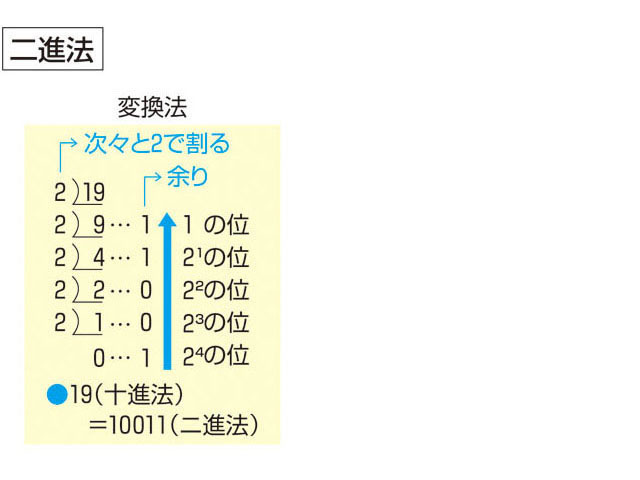

二進法
(2進法 から転送)
出典: フリー百科事典『ウィキペディア(Wikipedia)』 (2024/03/18 07:36 UTC 版)
注釈
- ^ 量子化とも言うが、量子物理におけるいわゆる量子のような意味(重ね合わせ状態など)ではない。
出典
- ^ Gordon, Raymond G., Jr., ed. (2005), “Kiwai, Southern”, Ethnologue: Languages of the World (15 ed.) 2008年3月12日閲覧。
- ^ Gordon, Raymond G., Jr., ed. (2005), “Sissano”, Ethnologue: Languages of the World (15 ed.) 2008年3月12日閲覧。
- ^ a b Lean, Glendon Angove (1992). “TALLIES AND 2-CYCLE SYSTEMS”. Counting Systems of Papua New Guinea and Oceania. Ph.D. thesis, Papua New Guinea University of Technology. オリジナルの2007年9月5日時点におけるアーカイブ。
- ^ Gordon, Raymond G., Jr., ed. (2005), “Melpa”, Ethnologue: Languages of the World (15 ed.) 2008年3月12日閲覧。
- ^ a b ライプニッツ『ライプニッツ著作集 10 中国学・地質学・普遍学』下村寅太郎ほか 監修、工作舎、1991年、p12。
- ^ Sanchez, Julio; Canton, Maria P. (2007), Microcontroller programming : the microchip PIC, Boca Raton, Florida: CRC Press, p. 37, ISBN 0-8493-7189-9
- ^ W. S. Anglin and J. Lambek, The Heritage of Thales, Springer, 1995, ISBN 0-387-94544-X
- ^ Bacon, Francis (1605), The Advancement of Learning (英語), vol. 6, London, Chapter 1
- ^ Claude E. Shanon (1937), A Symbolic Analysis of Relay and Switching Circuits, Massachusetts Institute of Technology, Dept. of Electrical Engineering
[続きの解説]
「二進法」の続きの解説一覧
2進法

「2進法」の例文・使い方・用例・文例
- 2進法のページへのリンク